Salesforce · AI Platform
Custom Propensity Scoring.
Building the no-code predictive ingestion layer for enterprise AI.
Overview
Custom Propensity Scoring is Salesforce’s first no-code, templated prediction builder designed to generate predictive behavioral metrics directly on top of Salesforce’s Customer Data Platform (CDP).
By embedding machine learning into a standardized, accessible setup wizard, the tool abstracts multi-tiered data science pipelines into low-friction UI building blocks. This enables non-technical enterprise users to safely configure and deploy predictive scores across cross-functional marketing campaigns, digital storefronts, and specialized sales strategies.
01
Context & the Core Problem.
In modern enterprise landscapes, connecting meaningfully with target audiences has become increasingly high-stakes due to volatile economic conditions and shifting market trends. When cross-functional teams want to execute customer touchpoints, they operate under a unified, high-level job to be done:
“When we communicate with our customers, we want to do so in a manner that is personalized to their unique context so we can drive higher engagement.”
True personalization is not an aesthetic luxury; it is an economic necessity. Data from McKinsey & Company establishes that organizations excelling at personalization generate 40% more revenue from those specific activities than average players.
However, personalization is an intricate process. Understanding individual customer preferences and calculating their next likely behavior is the critical first block of the journey. To tackle this, our team explored how Einstein (Salesforce’s AI engine) could increase the operational value of Salesforce’s Customer Data Platform (CDP) — a data infrastructure layer that aggregates customer data from disparate external sources into a single, centralized customer database containing all historical touchpoints and product interactions.
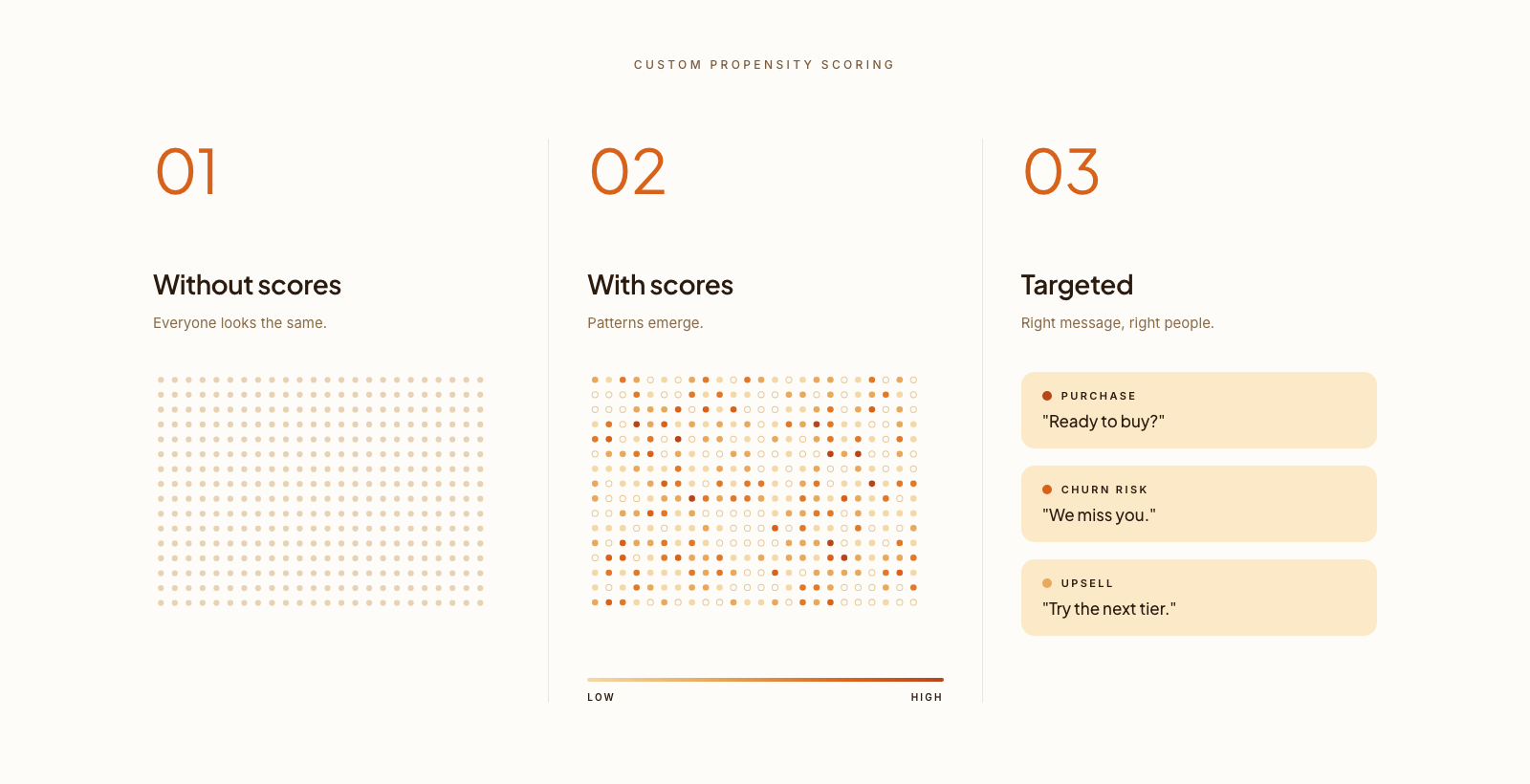
Impact at a glance
- Pilot → Global GA scaled from a three-customer pilot to a global General Availability release, serving core enterprise tenants.
- 1 utility patent US20240193466A1, protecting the no-code, multi-layered configuration wizard methodology.
- Validated in enterprise pilots with Athleta, PVR, and PGA Tour Superstore before the global rollout.
02
The Discovery Phase.
Rather than making assumptions about data science adoption, we anchored our exploration around three core validation streams: research insights, existing product limitations, and competitor capability maps.
Research insights.
In early 2022, we initiated an exploratory phase to figure out how contextual AI could effectively augment CDP capabilities. We evaluated our early workflow ideas through a qualitative research study consisting of deep-dive, 90-minute remotely moderated interviews with 8 domain experts (6 Enterprise Marketers, 2 Data Architects) representing a diverse mix of business verticals and disparate foundation databases.
The resulting synthesis was definitive: predictive modeling specifically tied to purchase intent and churn risk emerged as a top-3 critical feature requirement. The user validation was raw and urgent:
“Three years ago, we tried to build something exactly like this internally and it never had any legs. This is something our company actively wants, provided it works reliably. I would definitely use this.”
“I would absolutely use this… I think it would let me drill down to individual users or distinct segments and definitely tailor products more specifically to that group.”
The existing feature gap.
The technical urgency was further highlighted by evaluating our legacy architecture. In 2021, Salesforce had released an early predictive capability within the CDP to surface basic user engagement scores (such as email click and open rates). While the conceptual value proposition of these engagement scores was high, an architectural audit surfaced three crippling shortcomings:
- Feature inefficiency. The predictive models completely ignored the rich, multi-layered profile data natively resting inside the centralized CDP.
- Lack of functionality. The engine was narrow and technically unable to calculate deep business outcomes like Churn Risk or Purchase Propensity.
- Non-configurable structure. The user interface was completely static; users could not customize, tune, or configure the underlying predictive variables to match their real-world parameters.
This analysis revealed an enormous competitive runway. We needed to design a smart, configurable segmentation experience that could serve as an approachable, highly reliable first step in an enterprise personalization journey.
Navigating early ambiguity.
When I first joined this project, we faced a high degree of ambiguity across several foundational pillars of the experience. To establish a baseline, I collaborated closely with Product Management to map out our core architecture, seeking to answer:
- What are the key milestones of the end-to-end user journey?
- What specific data inputs do marketers need to provide?
- Where should this natively live within our ecosystem, and how will marketers leverage these scores downstream?
This exercise helped us define three core phases of the experience: Configure & Build, Review & Publish, and Leverage. With these pillars defined, I kicked off a series of rapid design iterations.
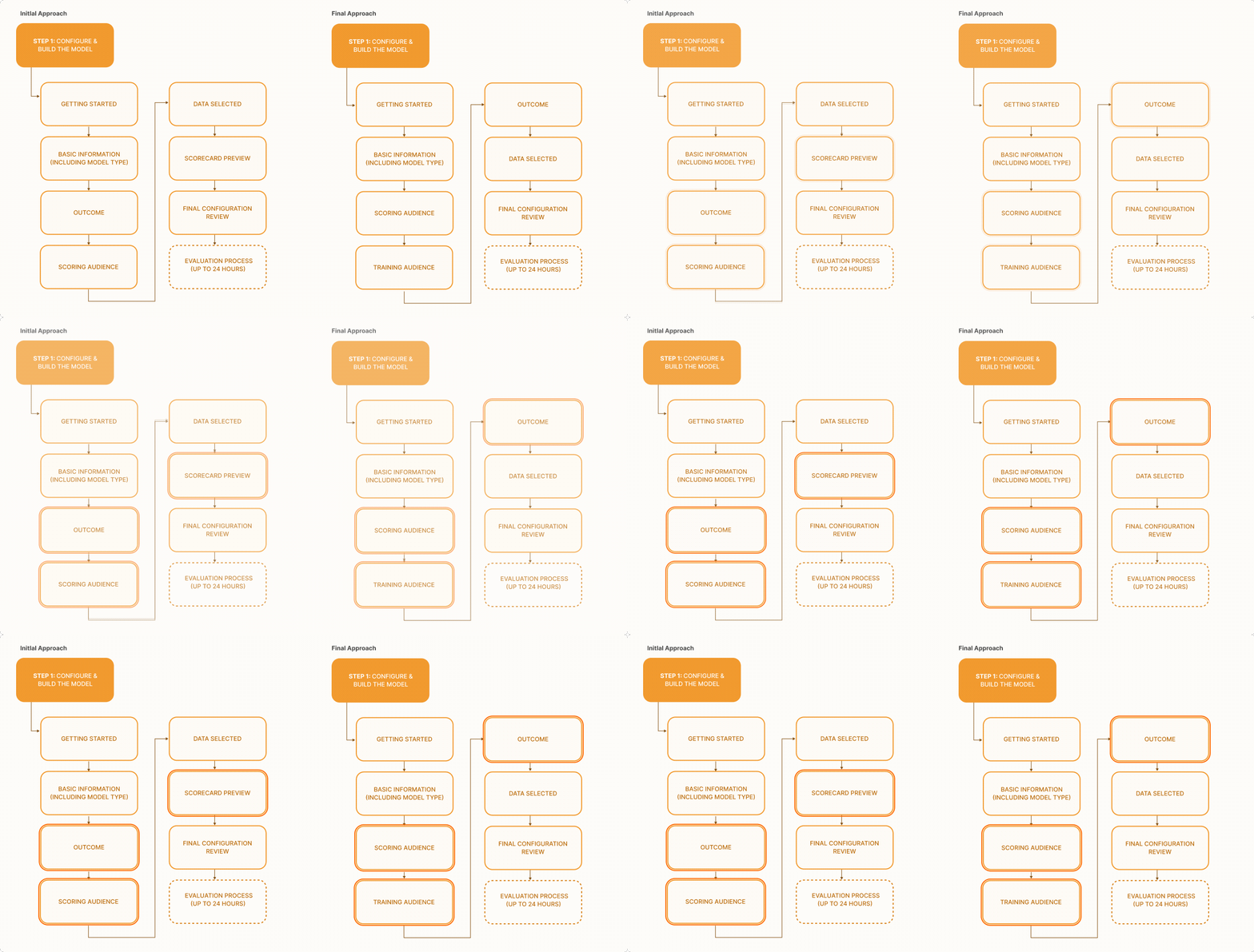
As shown on the left side of the visual above, our initial design prioritized the user's natural mental model by placing the Outcome definition step before selecting the audience and data inputs. Testing yielded three critical user insights:
- Outcome-first preference (validated). Users strongly preferred specifying their desired end-goal immediately. Marketers enter this workflow thinking about the business objective, confirming that configuring the outcome early reduces cognitive friction.
- Rule configuration friction. Setting up outcome filters proved confusing. Users found the manual multi-conditional logic complex and expressed anxiety over how their inputs would be interpreted.
- Trust through transparency. Model quality metrics are paramount for building trust. However, users noted that while positive indicators boosted confidence, they felt unequipped to remediate or troubleshoot a model if it reported poor performance.
The reality check: technical & strategic constraints.
Translating those user insights into a functional product required balancing ideal-state UX with strict data science realities.
- The schema mismatch (outcome vs. audience). Although testing validated that users prefer an outcome-first workflow, engineering spikes revealed severe technical limitations. Without isolating the target audience first, the backend engine could not determine the specific data object it needed to run predictions against. To bridge this gap without frustrating the user, we had to pivot our architecture to an "Audience-First" sequence (illustrated on the right side of the visual above). We also translated the broad idea of an "Outcome" into a "Training Audience" step, which simply tells the AI which past customer behaviors it needs to study and learn from.
- The model quality dilemma (Scorecard preview). While users loved having a model quality metric, surfacing this "Scorecard preview" at the very end of the creation wizard felt counterintuitive. It acted as a dead-end — if the scorecard preview indicated poor model quality, the system didn't offer actionable pathways to iterate on the underlying data inputs. To unblock the pilot, we deferred the complex remediation flows to a V2 release, choosing to focus MVP efforts on clear post-deployment status tracking instead.
- Scoping prediction timeframes. We initially aimed to give marketers full flexibility to customize prediction timeframes and lookback periods. However, to ensure a successful pilot, we strategically narrowed our scope. Based on direct feedback from a core pilot customer, we standardized the purchase propensity to a fixed 28-day timeframe with an identical 28-day lookback period. This lean approach allowed us to launch safely while gathering granular, real-world requirements for future iterations.
03
Balancing Human Logic with Machine Logic.
The primary UX challenge of this project was translating between two fundamentally different mental models to build a usable interface:
- The Human Mental Model (Abstract Goals): Marketers naturally think in business outcomes. They want to say, "Increase shoe sales," and expect the system to figure it out. This drove our initial outcome-first design.
- The Machine Mental Model (Historical Data): Predictive AI cannot understand abstract goals; it only understands data patterns. Before it can predict who will buy shoes, it needs the user to define a Training Audience — a historical group of people who already bought shoes — so it can study their behavioral patterns.
The system required users to configure these precise behavioral guardrails, so I had to design a progressive UI that guided them to think like the machine without making it feel like a rigid technical chore.
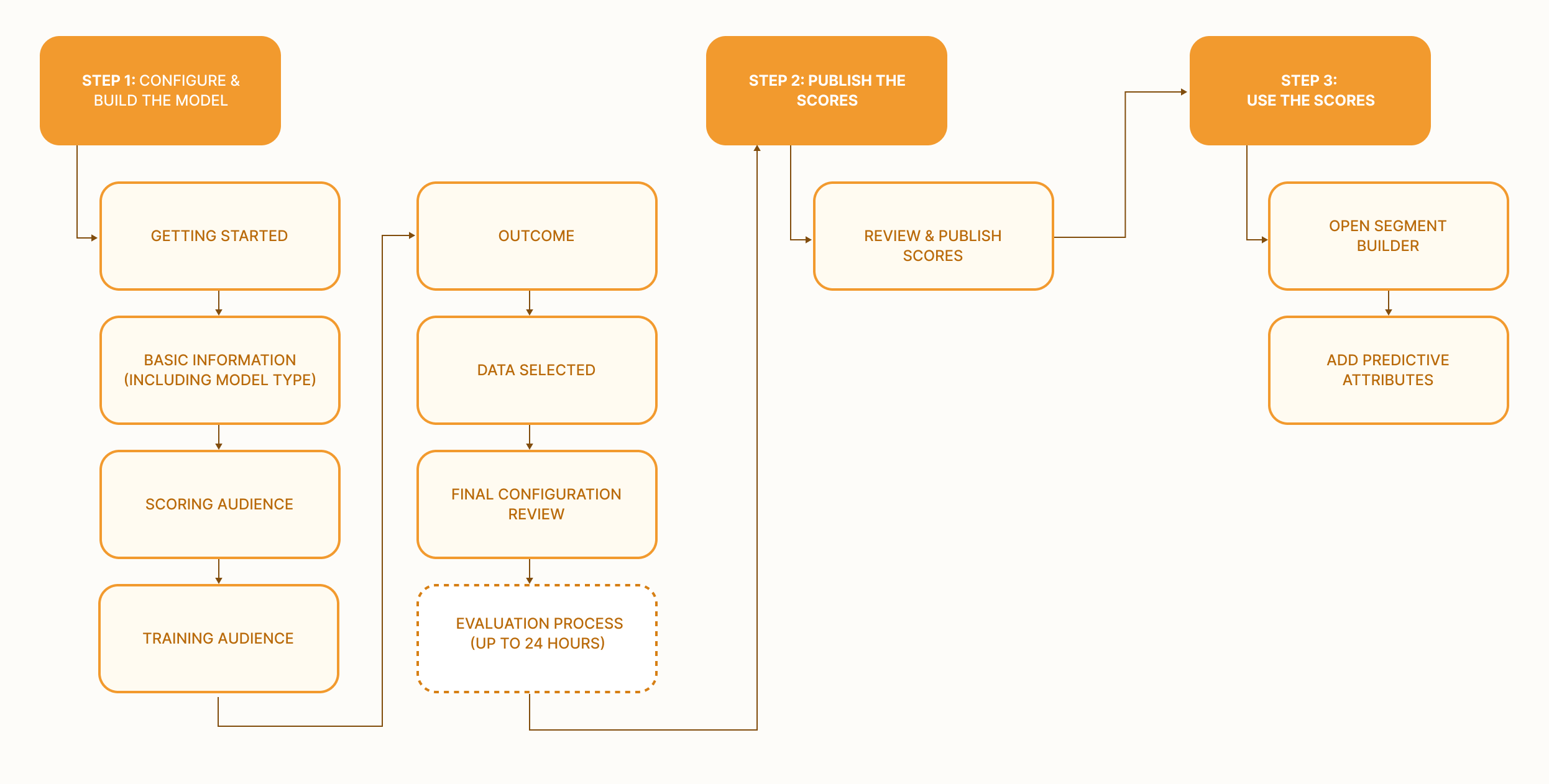
Bridging the schema mismatch with a persistent, natural-language summary banner.
To balance the required “Audience-First” technical constraint without making the UX feel like a rigid technical chore, I structured a clean, progressive configuration train. The system first isolates the broader target audience block, and then gracefully surfaces contextual conditional cards to let users map out specific actions.
To bridge the cognitive gap between the backend's needs and the user's mental model, I implemented a persistent, natural-language summary banner at the top of the viewport that dynamically compiled user selections into an understandable string.
Low-code outcome templates.
To abstract the complexity of manual rule generation, I introduced a system of contextual, pre-configured outcome templates. Instead of requiring marketers to construct multi-conditional logic strings from scratch, the interface surfaces standard, high-signal business objectives. Selecting a template instantly populates the underlying behavioral logic matrix, transforming a complex syntax-building task into a simple, high-confidence validation interaction.
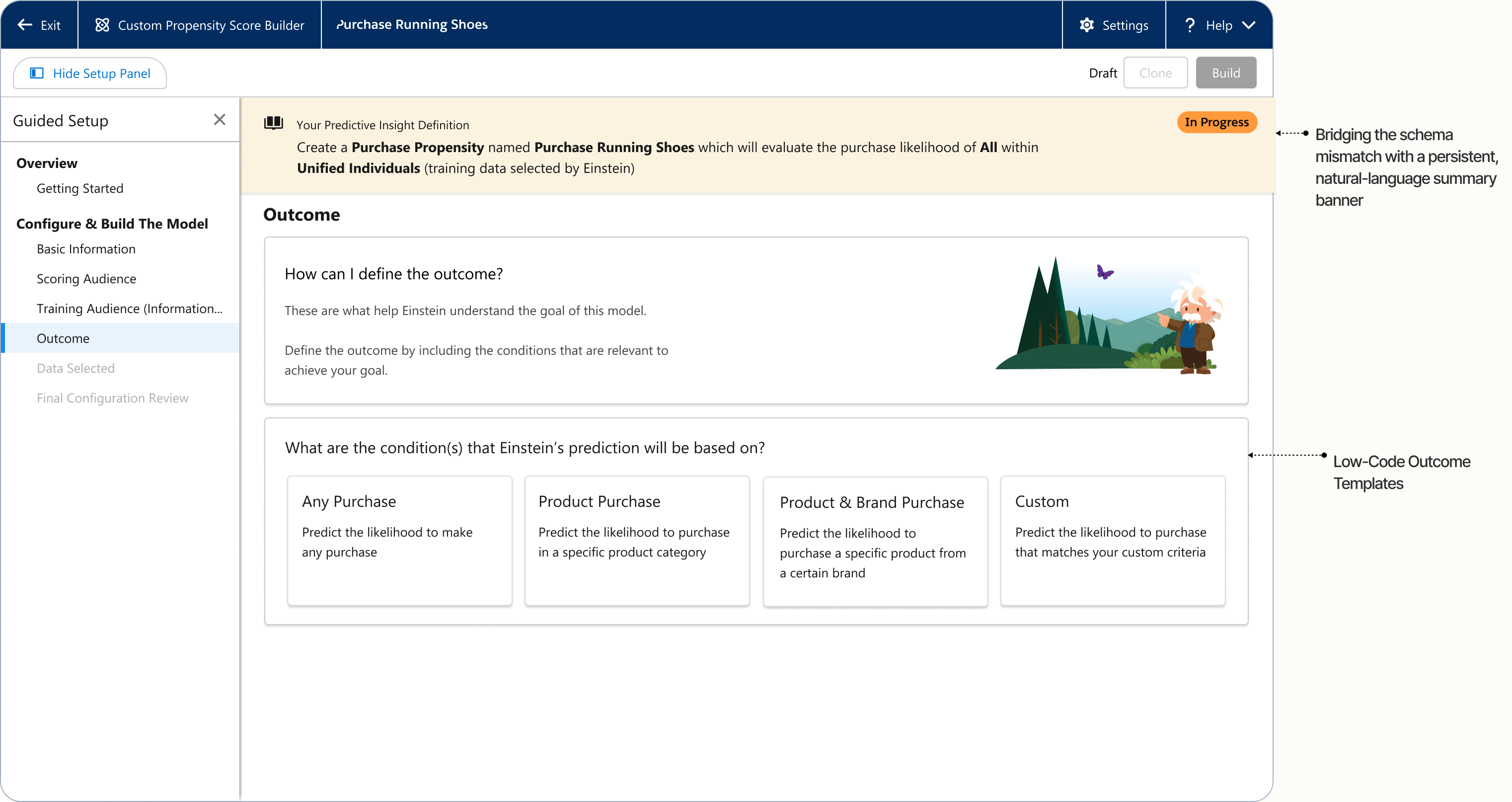
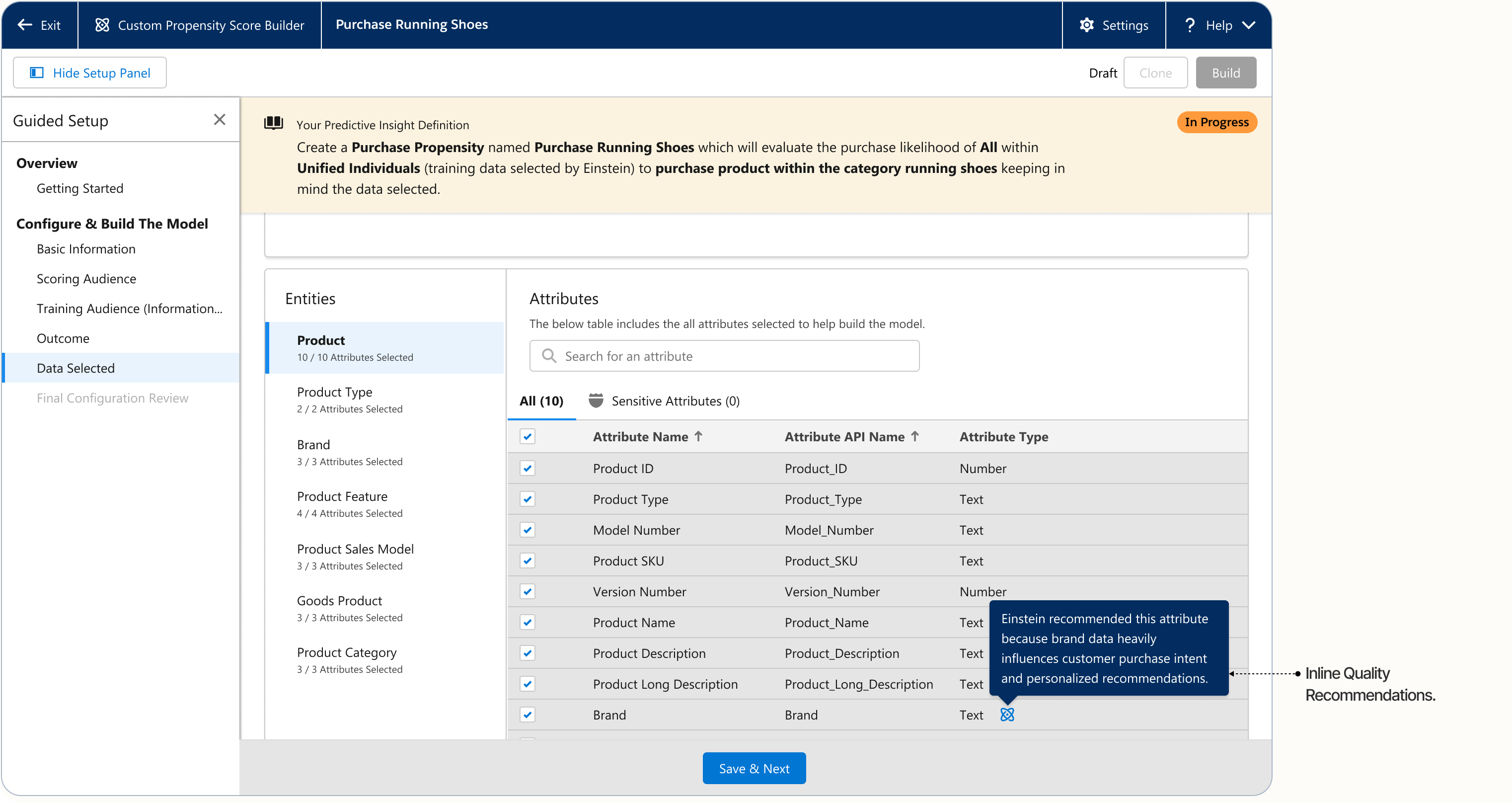
Inline quality recommendations.
Rather than relegating model quality to a passive, post-calculation review step, I integrated real-time prescriptive guidance directly into the data selection interface. As users configure data streams, the system evaluates data health in real time and dynamically surfaces inline recommendations for missing high-signal attributes. This shifts the experience from a retrospective error state to proactive coaching, allowing users to optimize data health before committing compute resources.
Ethical safeguards.
A critical requirement surfaced by our Data Architects was the need for absolute clarity regarding which customer attributes were being fed into the machine learning training loop. At the same time, we had to ensure users didn’t inadvertently train models on bias-heavy or legally non-compliant personal data points.
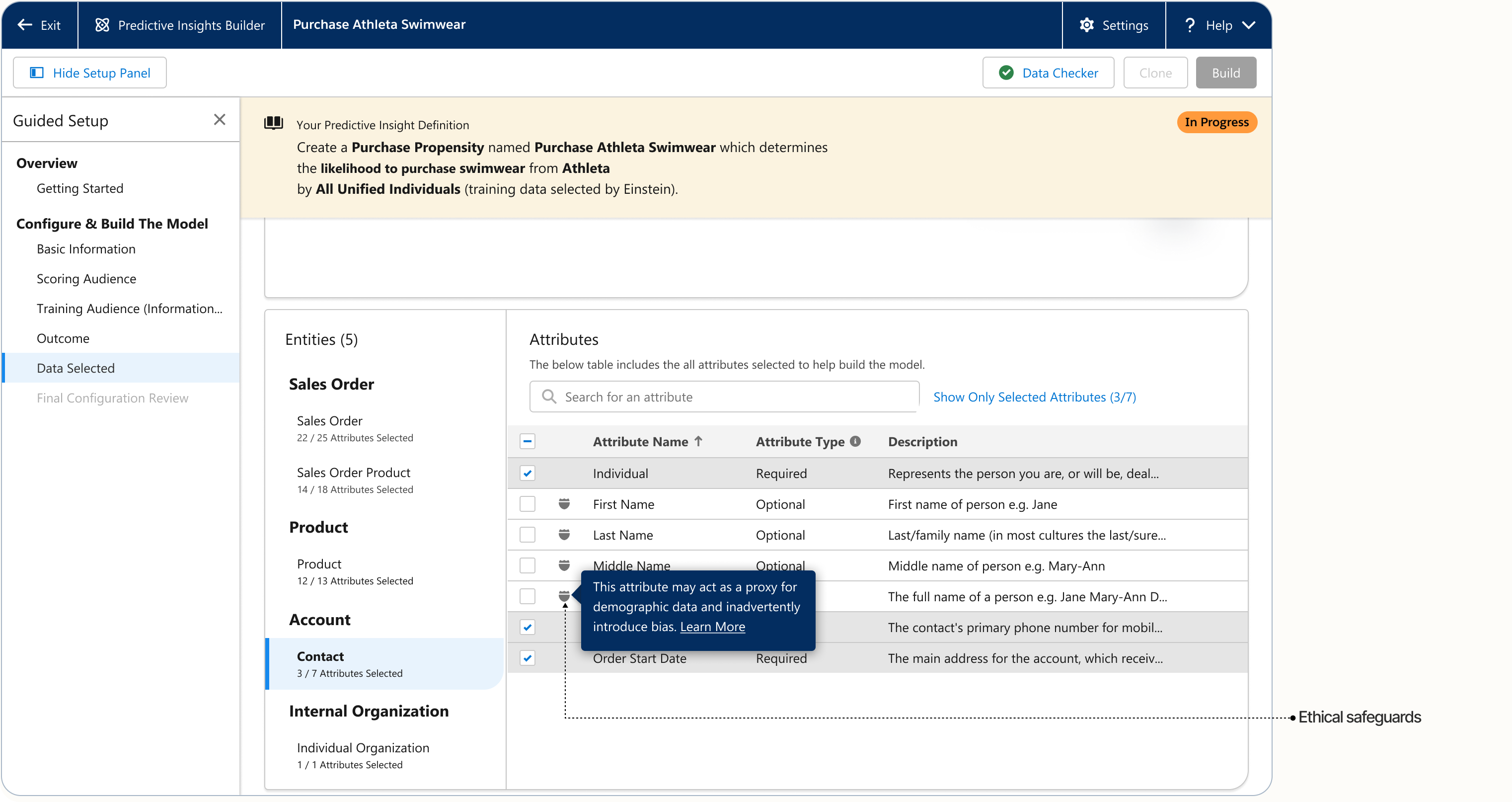
I designed a split-view data configuration screen that maps enterprise data assets into clear groupings. Working alongside our AI Ethics specialist, we built a dedicated “Sensitive Attributes” audit tab. The system automatically parses selected data tables and applies a clear Shield warning icon next to any fields that might introduce algorithmic bias, turning compliance management into a native part of the configuration workflow.
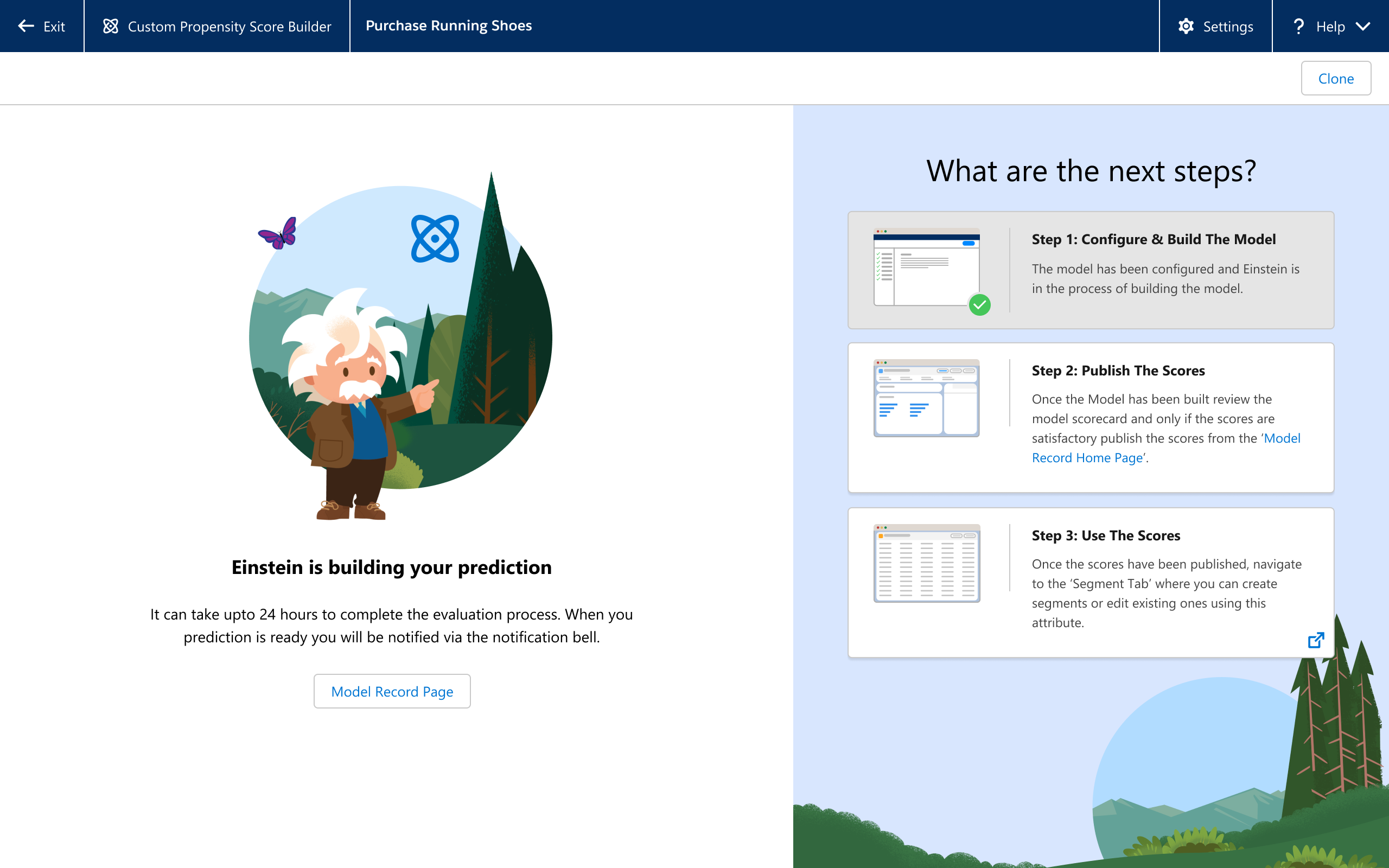
Orchestrating latency.
The final phase of the configuration flow focuses on cementing operational trust. Because training a predictive model across millions of enterprise records can incur up to 24 hours of back-end processing latency, the user interface had to provide clear confirmation before a user commits their operational resources.
Instead of showing a generic loading indicator that can cause anxiety during long processing runs, the post-submission screen explicitly outlines what is happening behind the scenes. It provides an illustrative processing status card and maps out clear downstream next steps (such as publishing scores and building segments), keeping users oriented throughout the wait cycle.
04
Business Impact.
-
Successful product scaling
Pilot to global GA.
Successfully guided the feature architecture from an early three-customer pilot phase to a global General Availability release, serving core enterprise tenants.
-
Intellectual property protection
Patent US20240193466A1
Filed and published a US utility patent legally protecting the multi-layered, no-code configuration wizard methodology designed to make complex data modeling accessible to non-technical operators.
Reflections & design takeaways
In enterprise AI application design, polished visual layouts are only effective if they directly align with underlying engineering and data structures. The real value of a product designer in this space lies in translation — building intuitive cognitive bridges over complex machine logic so everyday business users can execute advanced workflows with total confidence.