Salesforce · Sep 2023 to Jan 2026
Agentforce Campaign Creation.
Transforming the campaign grind into a fluid, AI-powered journey.
Overview
Agentforce Campaign Creation reimagines Salesforce’s marketing campaign lifecycle as an agentic experience, replacing a multi-week manual configuration grind with a conversational workspace that drafts, previews, and refines full multi-channel campaigns in minutes.
By grounding generative AI in brand guidelines, audience data, and prior campaign performance, and keeping the marketer in control through editable briefs and real-time re-steering, the product moves the user from “manual builder” to “strategic orchestrator.”
Impact at a glance
- ~70% adoption of all orgs with Agentforce activated, since the Spring ’26 rollout.
- >50% weekly active of adopted accounts, a sticky core weekly routine.
- Unlocked exec funding traction that resourced the broader Marketing Goals Agent · patent pending.
01
The Grind vs. The Goal.
Modern marketers are drowning in manual configuration. When teams are stuck fighting legacy tools, the customer experience degrades into fragmented, irrelevant noise. Teams become burnout-rich and insight-poor.
The mission wasn’t just to build a faster text generator. We needed to simplify the end-to-end campaign lifecycle, empowering marketers to build at the pace of an idea.
02
The Vision & The Guardrails.
To pull this off, we needed an engine built on two non-negotiable design pillars. Every downstream decision was anchored here:
- Robust Grounding: Anchoring AI in brand guidelines, historical data, and audience insights so the agent generates safe, relevant content.
- Human-in-the-Loop (HITL) Control: Giving the marketer a persistent, editable brief. The AI holds the pen, but the human steers the ship.

03
Navigating Constraints: The Architectural Evolution
Building ahead of the curve meant we had to continuously adapt our approach. To ensure we were always delivering the best possible user experience, we evolved the product architecture through four distinct phases, carefully balancing platform constraints, user-prioritized requirements, and rapidly expanding technical capabilities.

Draft With Einstein
We started with a focused, standalone experience to quickly validate the behavioral shift. Users loved the speed but gave us a clear mandate: We want the AI, but we need the steering wheel.

Einstein Copilot
To give users that steering wheel, we integrated into the platform’s native conversational assistant. But we hit a massive UX wall: the platform restricted us to a 300px utility panel. Users felt they were “orchestrating in the dark,” unable to visually connect their prompts to the campaigns they were building.
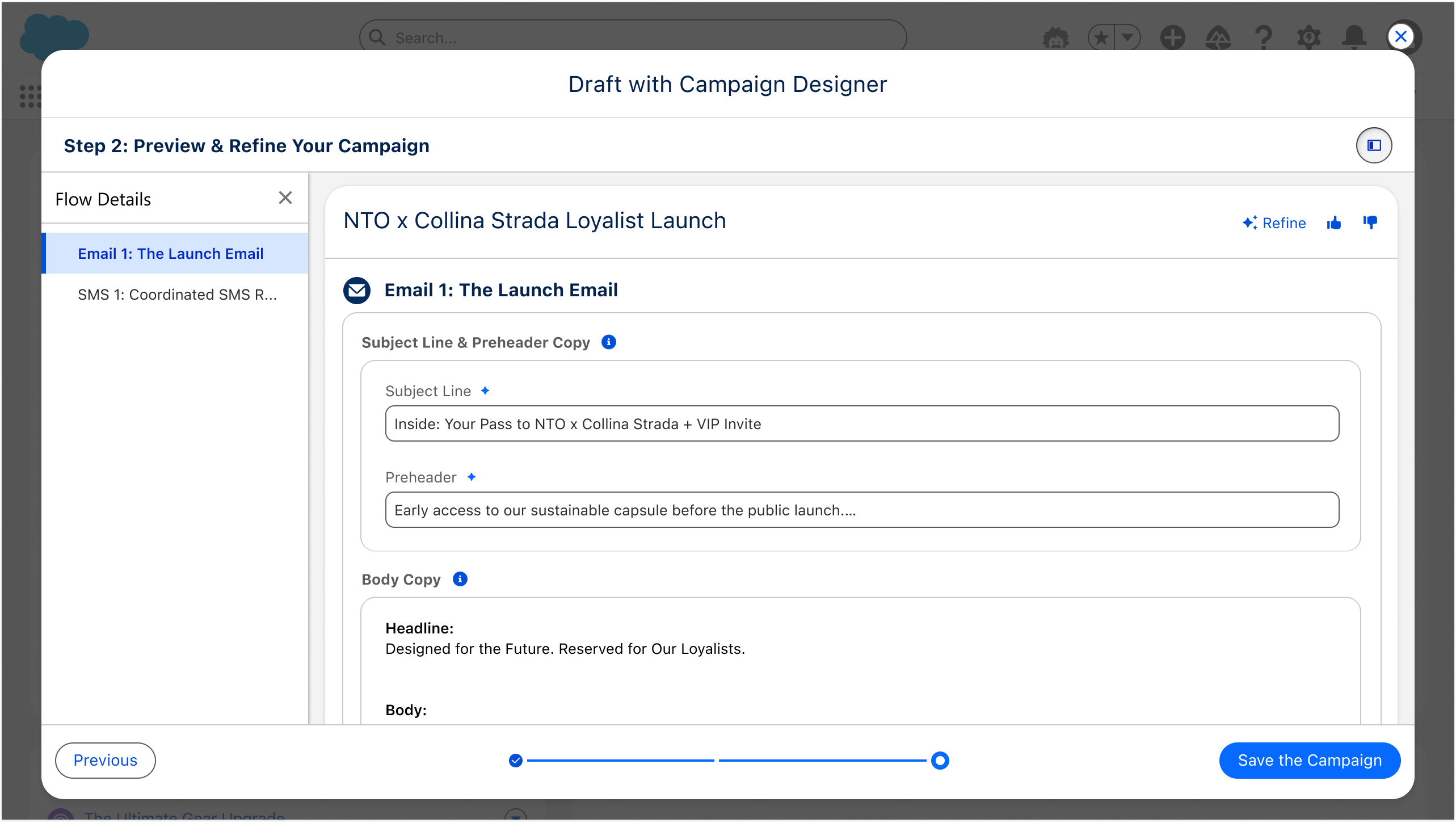
Campaign Designer
To solve the real-estate crisis, we broke free from the standard side-panel constraints. We custom-built a wide-canvas modal, finally giving marketers the expansive space and inline trust citations they needed.
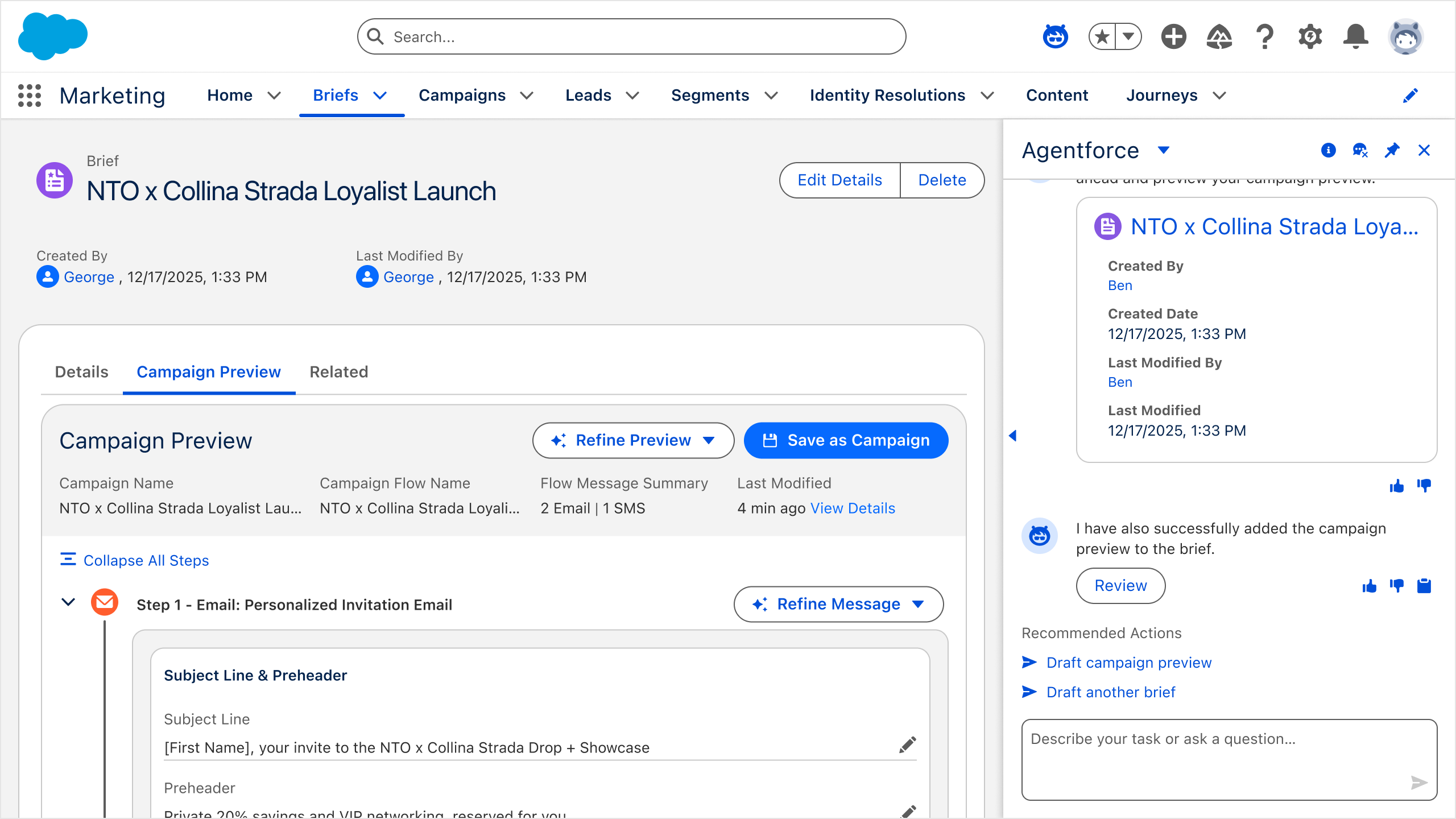
Campaign Creation Agent
As the core platform’s capabilities advanced, we were able to fully converge our vision natively. We brought the expansive visual canvas and the conversational agent together, culminating in the unified Agentforce Workspace.
Phase 01 / 04
04
Solving the Hard Problems: The Design Transformation
The evolution above is the what. This is the how: the hard problems I had to solve to make it real, all rooted in the second pillar: the AI holds the pen, the human steers the ship. Give marketers a surface they can steer, output they can trust, and control that doesn’t cost a prompt every time.
The surface: from a 300px panel to a canvas
Marketers can’t steer what they can’t see.
Phase 2 forced the sharpest decision of the project. The platform’s Copilot gave me reach, but it capped every AI feature at a 300-pixel utility panel, and marketers were orchestrating campaigns they couldn’t actually see. I scoped two very different ways out:
HMW help marketers build multi-channel campaigns with deep previews, and granular control?

Open Builder
Set asideA full canvas of its own.
- Draft vs. live blurred
- A new surface to learn
- Months of net-new build

Wide-canvas Modal
ChosenA modal that breaks the 300px cap.
- Whole campaign visible
- No new navigation
- Reused the modal shell
I chose the modal even though, at the time, Salesforce modals couldn’t yet host the conversational panel. The clarity win outweighed the constraint, and Phase 4 later closed that gap.
Then I tested it.
Before we wrote production code, I put the wide-canvas modal in marketers’ hands. About 90% said they’d adopt it on paper, but the score wasn’t the real signal, the behavior was. Watching real use surfaced two fixes I made before we shipped.
The step we cut
Draft the brief
Preview & Refine Your Campaign
Confirm & generate
Removed after testingWatching real use revealed a confirmation step marketers didn’t need, so I collapsed a three-step wizard into a leaner two-step workspace.
The interactive illusion
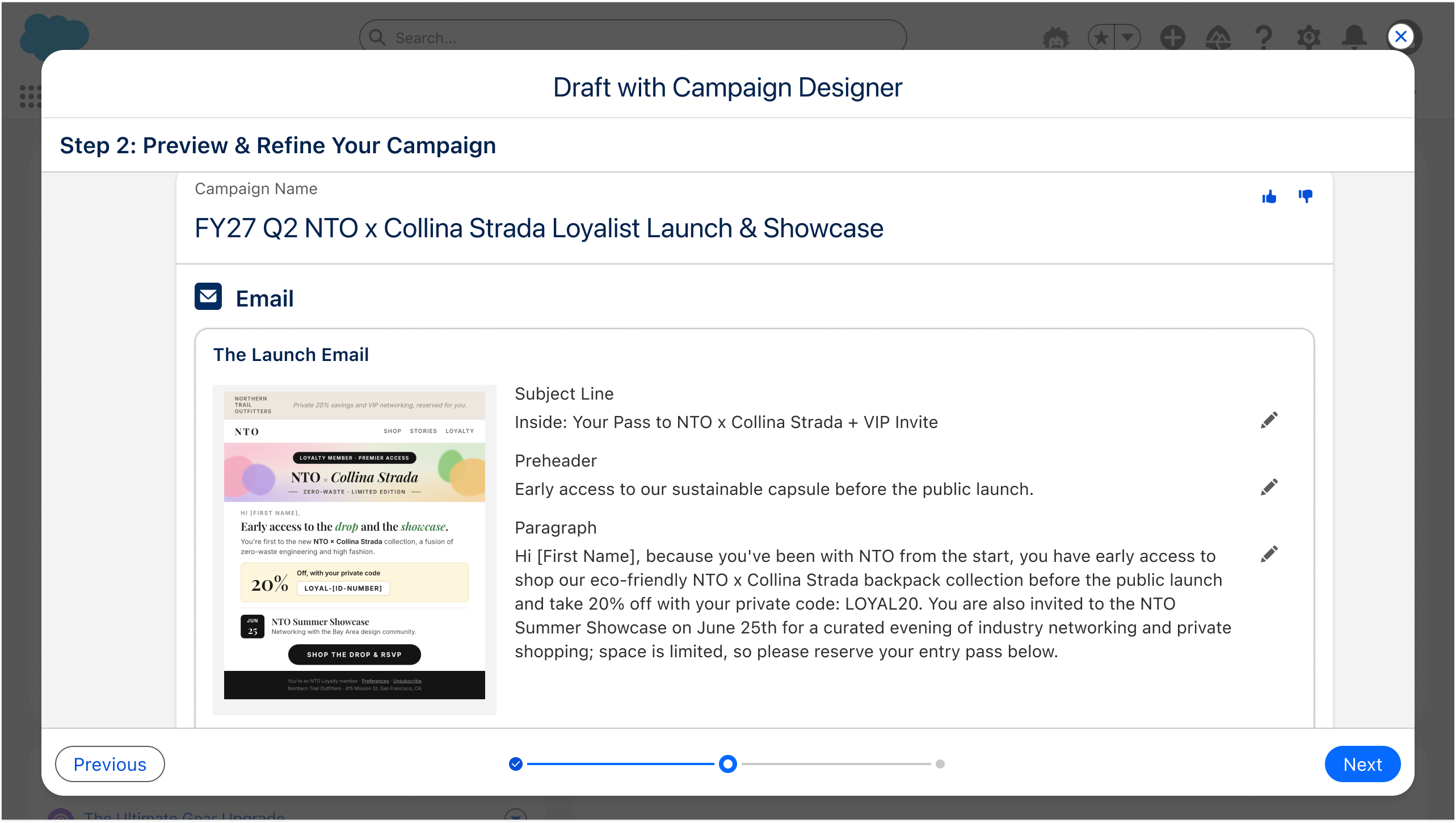
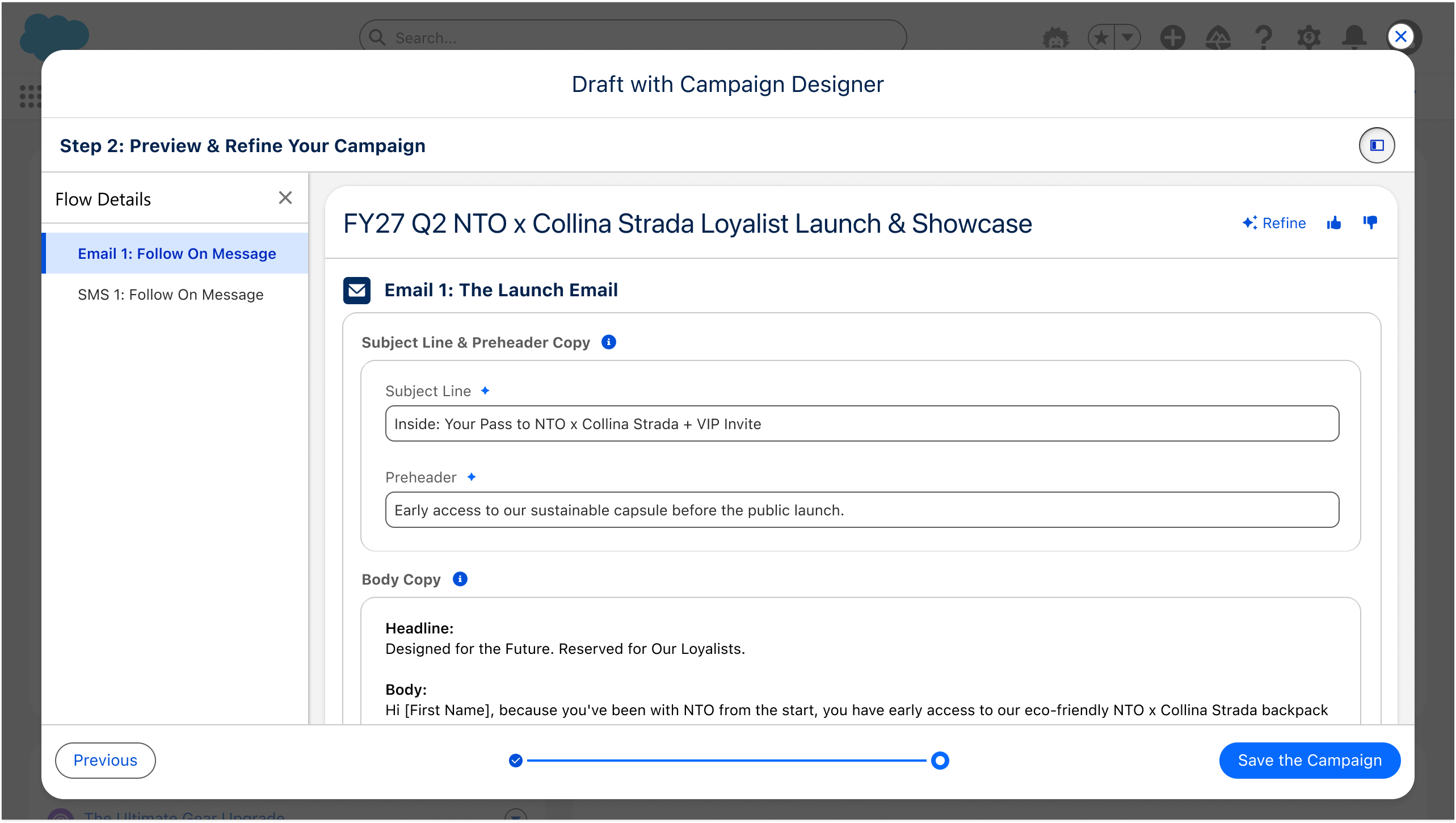
The polished preview looked editable, but marketers couldn’t touch the details they wanted to change. Stripping each message back to raw copy gave them a clear space to edit the words.
Because that same testing surfaced something deeper: two problems no amount of canvas space could fix. Marketers couldn’t always tell which words were theirs and which were the agent’s, and they were worn down re-typing prompts for small tweaks. Those two signals, trust and refinement fatigue, defined the next stretch of work, and ultimately converged in the native Phase 4 agent.
The output: designing for non-deterministic trust
Marketers can’t trust a pen they can’t audit.
The first of those Phase 3 signals, “who wrote what?”, was fundamentally a trust problem. An agent that drafts marketing content is only useful if the marketer trusts it. Three failure modes threatened that trust, and each one became a design problem I had to solve before the experience could ship:
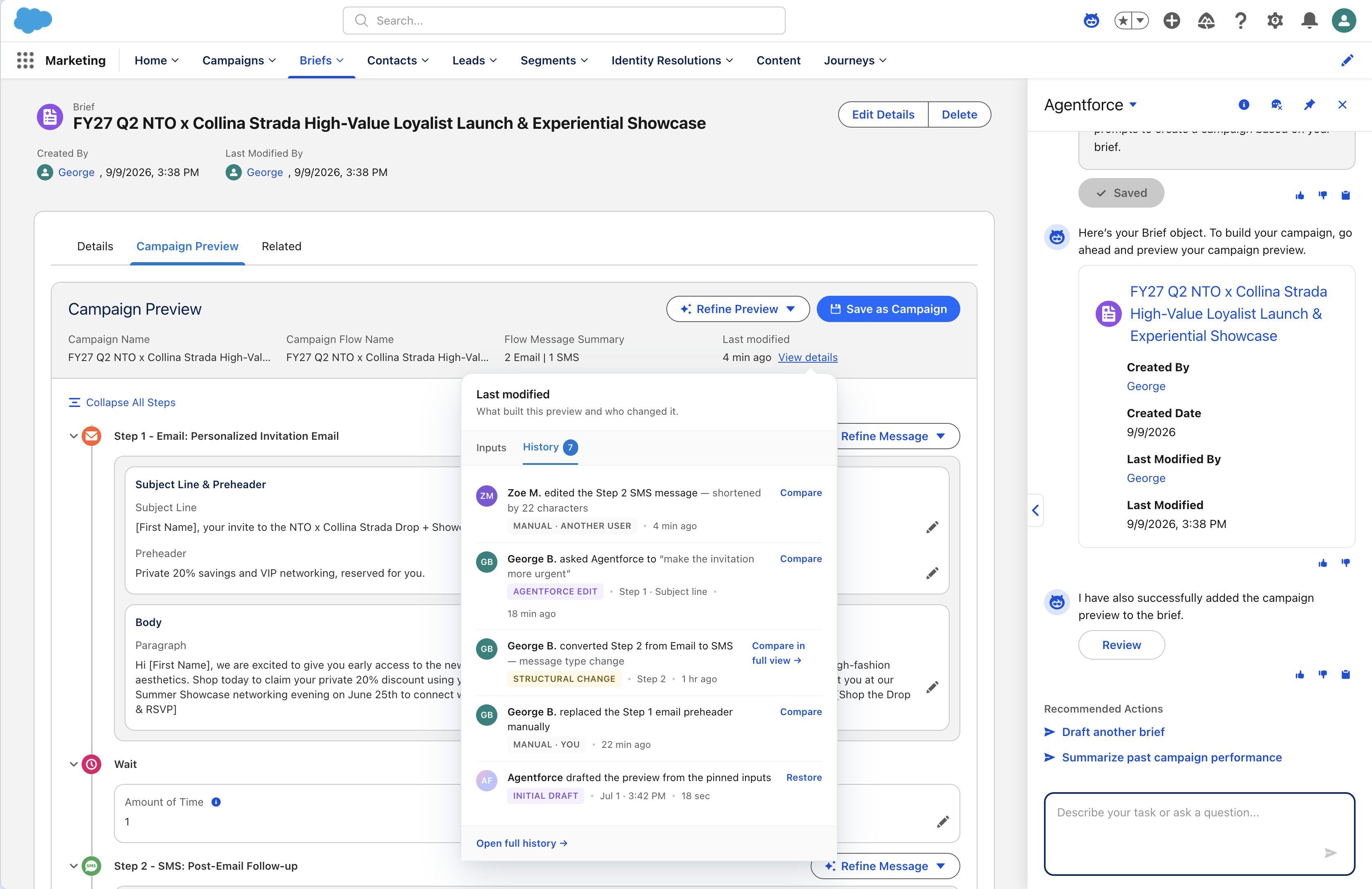
Lack of provenance
A persistent audit log tags every element as AI versus human authored, a transparent system of record for both the marketer and the model.
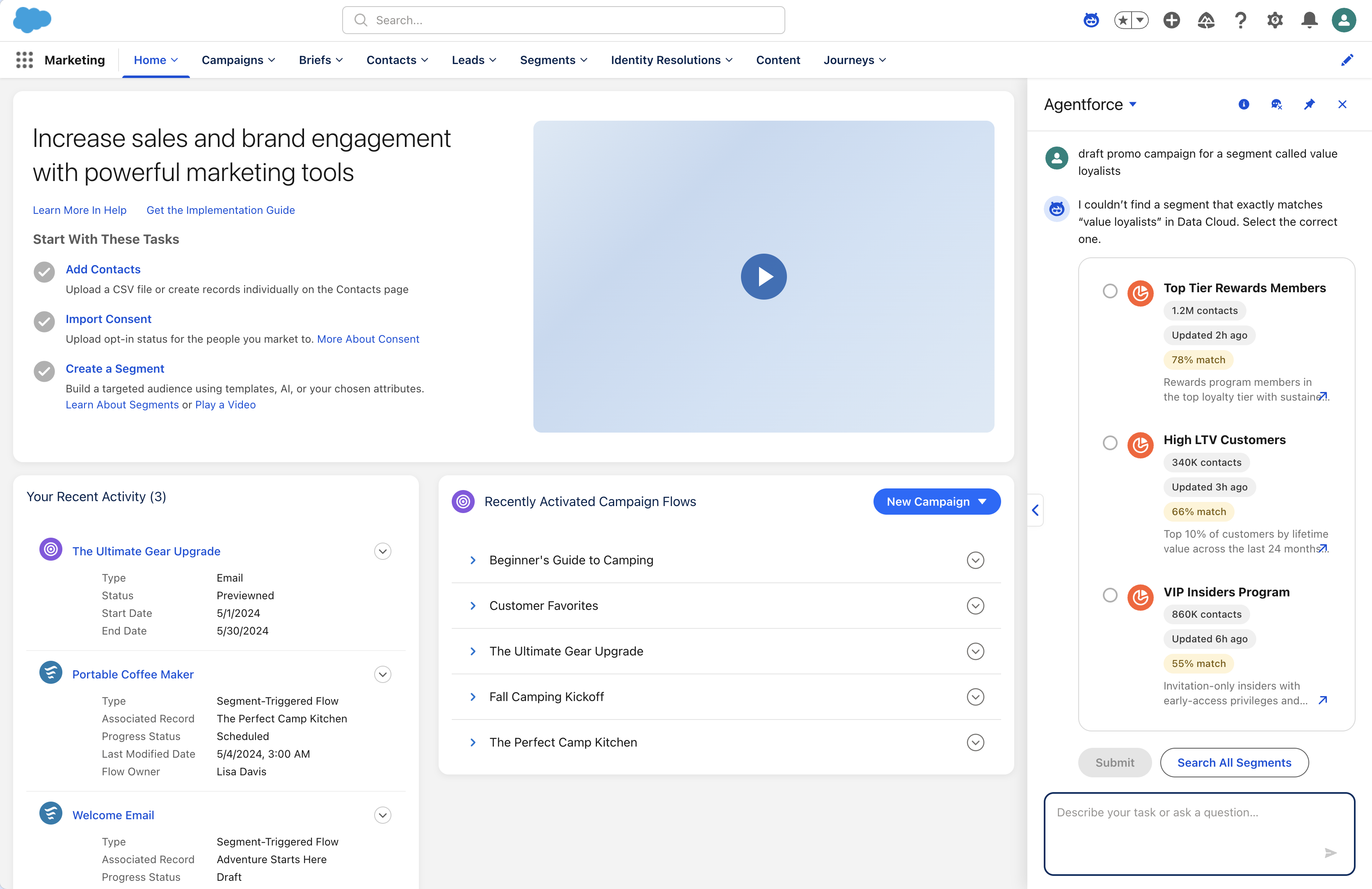
The vague prompt trap
LLMs are non-deterministic, so when a prompt lacked context I couldn’t let the agent guess. Conversational slot-filling and progressive-disclosure fallbacks guide the marketer into supplying the missing parameters, instead of failing silently or hallucinating.
Grounding failures
When the underlying CRM data is missing, the system detects it and surfaces a transparent grounding fallback before generation starts, so it fails gracefully rather than confidently producing something wrong.
The control: the agentic workspace & intent-based orchestration
Steering shouldn’t cost a prompt every time.
The second Phase 3 signal, refinement fatigue, is what pushed the design past the chatbox entirely. In its fully realized state, the Campaign Creation Agent bridges two distinct interaction models: conversational speed and visual control. When a marketer drops a prompt, the agent instantly drafts the brief and maps out a full multi-channel campaign on the expansive canvas. They get the big-picture view while keeping the conversational assistant docked for macro-level orchestration.
However, to combat “refinement fatigue” during micro-edits, we realized we needed to move beyond the chatbox entirely. We embedded quick actions directly onto the generated campaign nodes as intent-based direct manipulation controls. Now, instead of constantly typing prompts to make minor tweaks, users can express their intent through contextual actions: nudge tone, shorten a subject line, or regenerate a single step with a single click right where the content lives. We successfully blended the generative speed of AI with the precision of intent-based direct-manipulation UI.
05
The Impact.
The launch of the Campaign Creation Agent instantly validated our core UX hypotheses, converting raw market interest into deep operational utility. By targeting the heavy-lifting phase of marketing, specifically the Generate Campaign from brief workflow, we collapsed campaign creation from weeks to minutes. Since its debut in the Spring 2026 release, the tool has achieved rapid, sticky adoption and shifted the marketer’s daily reality from manual building to strategic orchestration.
-
Account adoption
~70% adoption.
Adopted by nearly 70% of all organizations that currently have Agentforce activated since the Spring ’26 rollout.
-
Weekly active use
>50% weekly active.
Highly sticky engagement: more than half of adopted accounts have turned this into a core weekly routine post-launch.
-
Executive investment
Funded for what’s next.
Proven commercial traction and visceral user utility directly accelerated executive funding and resourcing for the broader Agentforce Marketing Goals Agent.
Reflections & design takeaways
Generative AI doesn't replace marketing craft; it collapses the busywork that surrounds it. The design job here was less about the model and more about the scaffolding: giving marketers an obvious next step at every stage, and trustworthy ways to review, edit, and approve AI-drafted work before it ships.
Furthermore, this project underscored a massive shift in our craft. The center of gravity is moving from producing individual, static screens to architecting underlying systems. While my core focus here was system scaffolding, I have actively integrated AI-assisted coding tools like Claude and Cursor into my daily workflow. Redefining the traditional design-to-engineering handoff through functional, systems-oriented prototypes is the necessary next step for AI-native design.